
Background and Customer
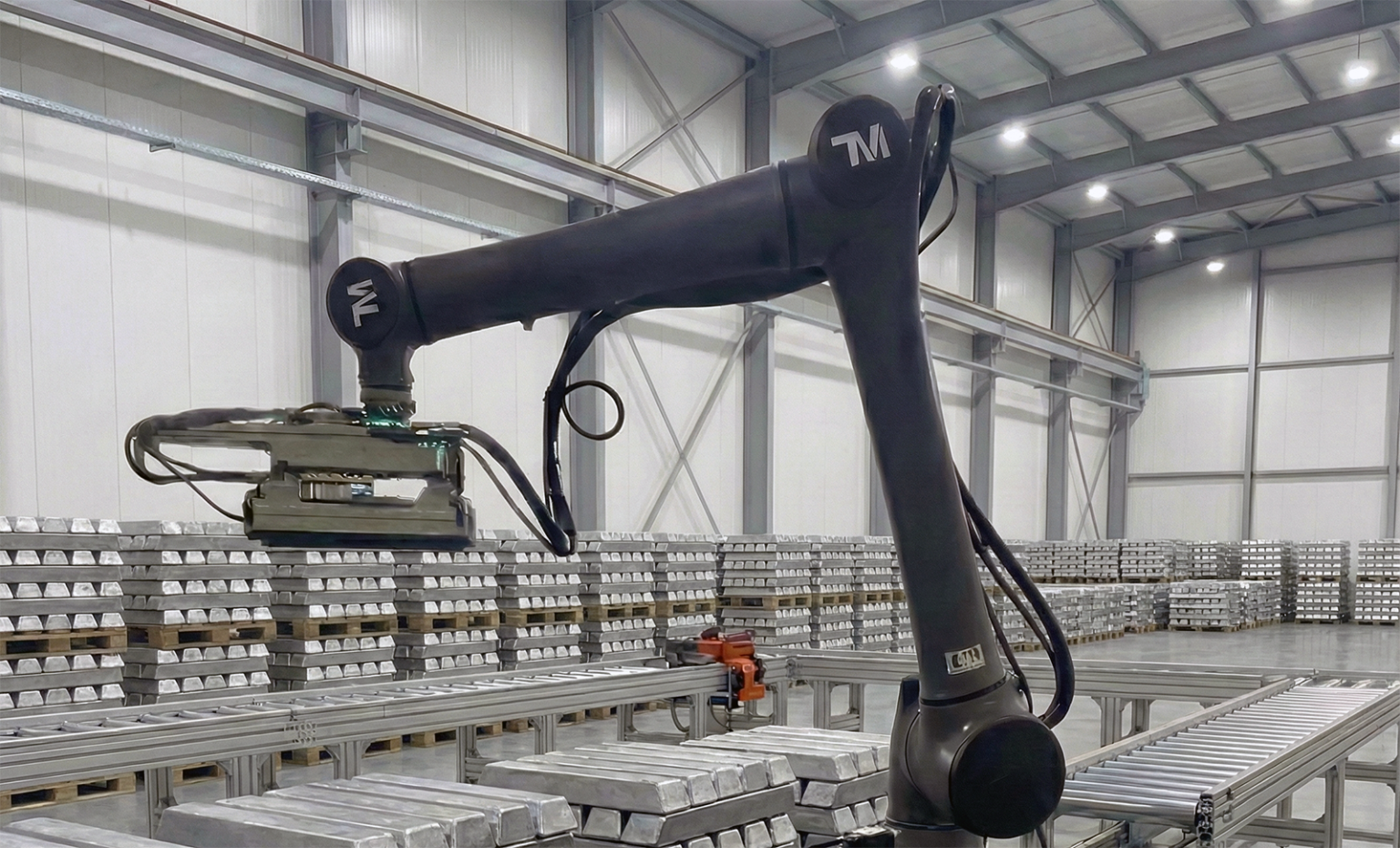
Needs An internationally renowned motorcycle manufacturer faced significant hurdles in the raw material handling section of their casting process. The line required processing aluminum ingots stacked 21 layers high, with each long ingot weighing 7kg. The client urgently sought an automated solution integrating robotic arms and AI vision to replace manual labor, aiming to resolve high labor costs and improve positioning accuracy.
Challenges
- Labor Intensity & Injury Risk:
Repetitive lifting of 7kg loads and constant bending posed severe occupational injury risks, compounded by a labor shortage. - Field of View (FOV) Limitations:
Due to the extended length of the ingots, a standard camera lens could not capture the entire object in a single frame at close range. - Complex Stacking:
The ingots were stacked in an alternating pattern across 21 layers with reflective surfaces, making depth and position detection difficult for traditional vision systems. - Cost Constraints:
The client sought a cost-effective alternative to expensive 3D camera systems.
Solution
We deployed a high-performance AI vision solution that leveraged software capabilities to overcome hardware limitations:
- AI Instance Segmentation (2D over 3D):
Instead of costly 3D cameras, we utilized AI Instance Segmentation technology. Through deep learning, the system accurately identifies the contours and layers of stacked ingots using standard 2D imaging, significantly reducing hardware costs. - Proprietary Positioning Algorithm:
To address the FOV limitation, we developed a specialized algorithm that detects the “top” and “bottom” ends of the long ingot separately. The system then automatically calculates the center coordinates, ensuring the robotic arm grips the center of gravity with precision.
Results & Benefits
- Enhanced Productivity:
A single robotic arm now supports a workspace covering four pallets, achieving a handling rate of 100 ingots per hour. - Cost-Effective Deployment:
By replacing expensive hardware with advanced AI algorithms, the client realized substantial savings on equipment investment. - Zero-Injury Workplace:
Automation has completely taken over heavy lifting, eliminating the risk of occupational injuries caused by long-term bending and load-bearing, creating a safer environment for employees.
Conclusion
This case study demonstrates how advanced AI software can effectively overcome physical hardware limitations. Through precise algorithms and a cost-effective 2D vision solution, we not only solved the complex challenge of aluminum ingot handling but also helped the client achieve a win-win situation in both production efficiency and workplace safety within their casting process.